
Stop being paid mainly for your time. Start being valued for what you know, see and solve.
(Delivering Value & Problem Solving)
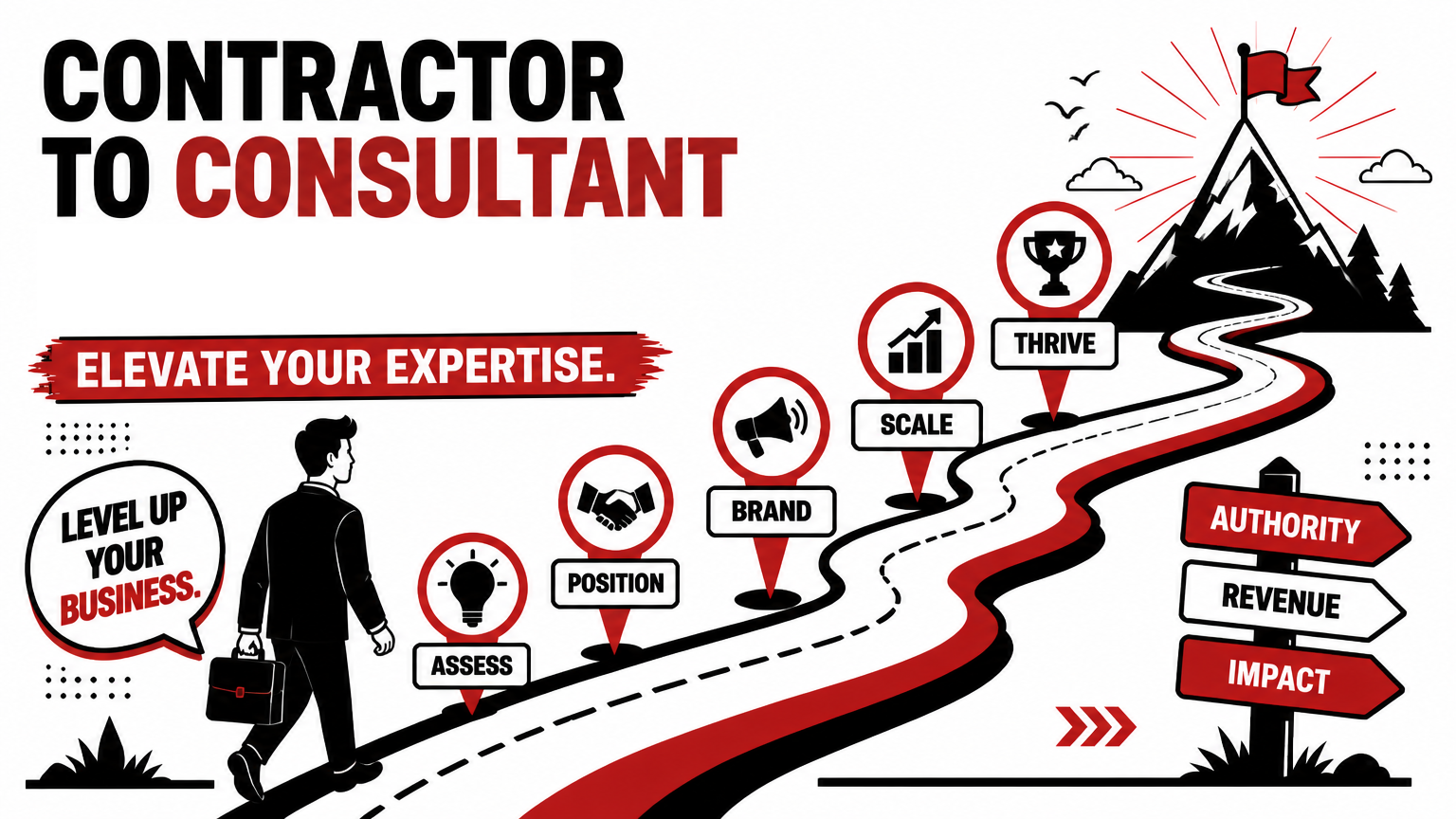
Contracting can be a powerful step away from traditional employment.
You gain independence.
You build commercial experience.
You learn to operate without the security and structure of an employer.
And you begin building a reputation based on what you personally deliver.
But eventually, many experienced contractors reach another question:
Am I being paid for my expertise or am I still mainly being paid for my time?
That is where the next Solo Move begins.
Contractor to Consultant is designed to help experienced contractors make the shift from providing capacity to creating value through expertise, judgement, insight and outcomes.
This isn’t about changing the title on your LinkedIn profile.
It’s about changing why clients engage you.
A contractor can be extremely valuable. A consultant learns how to make that value visible, differentiated and commercially meaningful.
Contractor and Consultant Are Not Just Different Words
The terms are often used interchangeably.
But there can be an important commercial distinction.
A contractor is often brought in because an organisation needs additional capacity or capability.
A consultant is more likely to be engaged because the organisation needs expertise, perspective, judgement, advice or an outcome.
One fills a requirement.
The other helps define, shape or solve it.
That doesn’t make consulting better than contracting.
And it certainly doesn’t mean every contractor should become a consultant.
But if you have accumulated years of experience, there may come a point where simply selling more days is no longer the best way to create — or capture — value.
The question changes from:
“What is my day rate?”
to:
“What is this problem worth solving?”
That is a very different commercial conversation.
The Ceiling of Contracting
Contracting can be financially rewarding.
But it contains a structural limitation.
You can only sell so many days.
You can increase your rate.
Work longer.
Take shorter breaks.
Negotiate better contracts.
Move into more specialised assignments.
All of those can increase your income.
But eventually:
Time × Rate = Revenue
starts to become a constraint.
If the only way to earn more is to sell another day, your income remains closely connected to your availability.
Consulting begins to challenge that relationship.
Not by pretending your time has no value.
But by recognising that your accumulated knowledge, experience, methodology, judgement and ability to solve problems may be worth more than the hours required to apply them.
You May Already Be Consulting
There is an interesting point in many contractors’ careers.
They are engaged as contractors.
They invoice by the day.
But clients increasingly ask them:
- “What do you think?”
- “What would you do?”
- “Can you take a look at this?”
- “Why isn’t this working?”
- “How should we approach it?”
- “Can you help us work this out?”
Those questions matter.
Because the client is no longer simply asking for your labour.
They are asking for your judgement.
And judgement is accumulated.
- Through experience.
- Mistakes.
- Pattern recognition.
- Technical knowledge.
- Commercial understanding.
- Context.
And years spent learning what works and what doesn’t.
The question is whether your commercial model has caught up with the value you’re already providing.
The Next Solo Move
The first transition was:
EMPLOYEE to CONTRACTOR
You moved from organisational dependence towards professional independence.
The next transition can be:
CONTRACTOR to CONSULTANT
But this move requires another change in thinking.
As a contractor, the question is often:
“What do you need me to do?”
As a consultant, the question increasingly becomes:
“What are you actually trying to achieve?”
That shift sounds subtle.
Commercially, it can change almost everything.
Consulting Is Not About Knowing Everything
One of the biggest barriers experienced professionals face when considering consulting is the belief that they need to become an all knowing expert.
You don’t.
Good consultants don’t necessarily have all the answers.
They know how to:
- Ask better questions.
- Recognise patterns.
- Clarify problems.
- Structure ambiguity.
- Bring relevant experience.
- Challenge assumptions.
- Help people make decisions.
- Create practical pathways forward.
And know when something sits outside their expertise.
Consulting isn’t about having all the answers.
It’s about helping clients reach better ones.
What You’ll Learn
Contractor to Consultant explores the commercial, behavioural, and positioning changes involved in moving from providing professional capacity to selling expertise, judgement, and outcomes.
It helps you examine not simply what you do, but why a client should engage you to do it.
From Capacity to Expertise
Understand what clients are actually buying.
Contractors and consultants can perform very similar work.
The distinction often lies in why they are engaged.
A contractor may provide additional capability inside an existing structure.
A consultant may help the client determine what that structure, solution or direction should be.
You’ll explore:
- Contractor thinking vs consultant thinking
- Capacity vs expertise
- Execution vs judgement
- Why clients engage consultants
- Recognising where you already provide advisory value
- Moving from instructions towards outcomes
- Understanding the commercial value of experience
The work may look similar. What the client believes they are buying can be completely different.
Stop Selling Your CV
Your experience matters. But your client has a problem.
Experienced professionals often describe themselves through their history.
- Years of experience.
- Industries worked in.
- Qualifications.
- Projects delivered.
- Companies worked for.
- Job titles held.
All of that establishes credibility.
But clients rarely wake up thinking:
“I need someone with 27 years of experience.”
They wake up thinking:
“We have a problem.”
Your positioning connects your experience to that problem.
You’ll explore:
- Credentials vs relevance
- Turning experience into client value
- Identifying recurring problems you solve
- Translating capability into outcomes
- Making your expertise easier to understand
- Why a long CV is not a value proposition
- Positioning around problems rather than job titles
Your Experience Is Raw Material
Years of experience alone don’t automatically create a consulting proposition.
Experience needs to be interpreted.
Look back across your career.
- What problems keep appearing?
- What do people repeatedly ask you for help with?
- What can you see quickly that others struggle to recognise?
- What mistakes have you learned to avoid?
- What decisions can you make with greater confidence because you’ve seen the pattern before?
- What have you developed a point of view about?
Those things can become commercially valuable.
Your consulting proposition often already exists inside your experience.
The work is learning how to extract it.
Find the Problem You Solve
General expertise is difficult to buy.
If you tell someone:
“I have extensive experience and can help organisations improve performance.”
They may agree.
But they still don’t necessarily know when to call you.
A strong consulting proposition creates recognition.
The client hears it and thinks:
“That’s the problem we have.”
You’ll explore:
- Identifying commercially meaningful problems
- Symptoms vs root problems
- Understanding the client’s language
- Narrowing without unnecessarily limiting yourself
- Connecting expertise to business consequences
- Why specificity improves relevance
- Becoming easier to refer
If people don’t know what problem to associate with you, they won’t know when to call you.
From Deliverables to Outcomes
Clients don’t ultimately want your PowerPoint presentation.
- They don’t really want the report.
- The workshop.
- The spreadsheet.
- The framework.
- The assessment.
- The strategy document.
- Those are deliverables.
What they actually want is what those deliverables help them achieve.
- Clarity.
- Reduced risk.
- A better decision.
- Improved performance.
- Capability.
- Compliance.
- Confidence.
- Cost reduction.
- A successful change.
- A problem resolved.
You’ll explore:
- Deliverables vs outcomes
- Understanding the client’s desired future state
- Asking better discovery questions
- Moving beyond the stated scope
- Understanding why the work matters
- Connecting your contribution to organisational value
- Avoiding the trap of selling activity
Ask Better Questions Before Offering Better Answers
One of the strongest consulting behaviours is also one of the simplest.
Don’t solve the problem too quickly.
Experienced people recognise patterns.
That’s useful.
But it also creates a temptation to hear a few sentences and immediately say:
“I know what you need.”
Sometimes you’re right.
Sometimes you’re solving the wrong problem extremely efficiently.
A consultant needs to understand:
What is happening?
Why does it matter?
Who does it affect?
What has already been tried?
What constraints exist?
What happens if nothing changes?
What does success actually look like?
Diagnosis comes before prescription.
That principle alone can dramatically change how clients experience your expertise.
Productise What You Know
Not every consulting engagement needs to start with a blank sheet of paper.
Over time, you may notice that similar client problems require similar approaches.
You ask similar questions.
Run similar workshops.
Use similar frameworks.
Perform similar assessments.
Create similar deliverables.
Follow similar sequences.
That repetition can become an asset.
Instead of selling:
“Martin for 20 days.”
you can begin selling:
“A defined process that takes you from this problem to this outcome.”
You’ll explore:
- Identifying repeatable intellectual property
- Frameworks, methods and diagnostic tools
- Turning experience into a process
- Creating defined consulting offers
- Scope and boundaries
- Repeatability without becoming generic
- Why productisation can improve both delivery and sales
Your IP Doesn’t Need to Be Revolutionary
Many professionals get stuck here.
They assume intellectual property means inventing something nobody has ever seen before.
It doesn’t.
Your IP may simply be:
- Your sequence.
- Your framework.
- Your diagnostic questions.
- Your assessment method.
- Your model.
- Your workshop structure.
- Your decision process.
- Your way of bringing several established ideas together.
The value isn’t necessarily that nobody else could do it.
The value is that you’ve made your expertise repeatable, explainable and usable.
Pricing Beyond the Day Rate
Your day rate is useful. But it doesn’t have to define everything.
Day rates are familiar.
Clients understand them.
Contractors understand them.
Procurement understands them.
And for many engagements, they remain entirely appropriate.
The problem arises when your commercial thinking stops there.
If you become faster because of your experience, should you automatically earn less?
If a problem takes you two days to solve because you’ve spent twenty years learning how to solve it, is the value really just two days?
You’ll explore:
- The strengths and limitations of day-rate pricing
- Project and fixed-fee approaches
- Pricing defined engagements
- Connecting scope, risk and price
- Why value matters when thinking about price
- Avoiding arbitrary value-pricing claims
- Understanding your commercial floor
- When a day rate remains the right model
The objective isn’t to eliminate day rates. It’s to stop allowing the day rate to be the only way you understand your value.
Scope Is a Commercial Skill
Consultants need to know where the work ends.
One of the easiest ways to destroy consulting economics is uncontrolled scope.
A small additional request.
Then another.
Then another.
Soon the engagement you priced around one outcome has quietly become three.
Good scope isn’t about becoming difficult.
It creates clarity.
For you.
And for the client.
You’ll explore:
- Defining scope around outcomes and deliverables
- Assumptions and exclusions
- Managing ambiguity
- Change requests
- Scope creep
- Protecting relationships while protecting commercial boundaries
- Recognising when additional work creates another opportunity
Saying Yes to Everything Doesn’t Make You a Better Consultant
Clients value responsiveness.
But responsiveness and unlimited availability are not the same thing.
Your role isn’t to become permanently embedded in every problem the client encounters.
In fact, one of the signs of strong consulting can be your ability to create clarity about:
What matters.
What doesn’t.
What you will do.
What the client needs to do.
And when the engagement is complete.
Boundaries create confidence.
Build Authority Without Becoming a Personal Brand Machine
You don’t need to become an influencer.
Consultants do benefit from visibility.
But visibility doesn’t mean posting motivational content every morning.
It means making your thinking discoverable.
- An article.
- A framework.
- A presentation.
- A case study.
- A podcast.
- A useful LinkedIn post.
- A conversation.
- A recommendation.
- A workshop.
- A point of view.
Each gives potential clients evidence of how you think.
You’ll explore:
- Credibility vs visibility
- Building authority through useful thinking
- Creating evidence of expertise
- Developing a professional point of view
- Using content without becoming a content creator
- Reputation and referrals
- Becoming known for something useful
You don’t need everyone to know who you are.
You need the right people to understand why they might call you.
Selling Without Becoming a Salesperson
Consulting requires commercial conversations.
For many experienced professionals, this is uncomfortable.
You may be very comfortable delivering work.
But less comfortable asking for it.
The good news is that good consulting sales doesn’t need to feel like traditional selling.
It can look remarkably similar to good consulting.
Ask questions.
Understand the problem.
Explore consequences.
Clarify the desired outcome.
Determine whether you can help.
Define an appropriate approach.
Then make a commercial proposal.
You’ll explore:
- Consulting conversations
- Discovery before solution
- Qualification
- Understanding urgency and value
- Discussing money
- Proposals
- Follow-up
- Knowing when to walk away
- Selling through expertise rather than pressure
Not Every Prospect Should Become a Client
This becomes increasingly important as you move towards consulting.
A potential client may:
Have unrealistic expectations.
Want an outcome you cannot control.
Have no genuine sponsorship.
Lack the resources required to implement your advice.
Want free expertise disguised as a sales conversation.
Have a problem outside your capability.
Or simply be a poor fit.
Saying no can be commercially intelligent.
The goal isn’t to win every opportunity.
The goal is to build a sustainable consulting practice around the right ones.
From One Client to a Practice
Independence becomes fragile when one client represents your entire business.
Many contractors leave employment only to recreate it commercially.
- One client.
- Five days a week.
- Long contract.
- Client systems.
- Client email address.
- Client priorities.
- Client dependency.
Again, that isn’t automatically wrong.
It can be an excellent commercial arrangement.
But if your objective is to build a consulting practice, eventually you need to create greater independence.
You’ll explore:
- Client concentration
- Building a pipeline
- Repeat work and referrals
- Balancing delivery and business development
- Multiple-client models
- Creating commercial resilience
- Recognising when you’ve simply recreated employment
- Building a practice rather than another job
The Consultant’s Dilemma
When you’re busy, you don’t have time to find work.
When the work finishes, you suddenly have plenty of time.
That cycle is a reality of independent consulting.
The solution isn’t constant selling.
It’s maintaining enough visibility, relationships and pipeline activity while you’re busy that the next opportunity doesn’t always begin from zero.
Business development isn’t something you do only when you need business.
It is part of the work.
What You’ll Walk Away With
By the end of Contractor to Consultant, you should have a clearer understanding of:
- The commercial difference between contracting and consulting
- Whether you’re already providing consulting value without positioning it that way
- What expertise clients may genuinely value from you
- The problems your experience equips you to solve
- How to describe your value without relying on your CV
- How to move conversations from deliverables towards outcomes
- How to diagnose before prescribing
- How your expertise could become a repeatable methodology or offer
- How to think beyond day-rate-only pricing
- How to establish stronger scope and commercial boundaries
- How to build authority without becoming an influencer
- How consulting sales can operate as a professional conversation
- How to become less dependent on a single client
- How to start building a practice rather than simply creating another job
Most importantly:
You’ll start seeing your accumulated experience as a commercial asset — not simply a history of work you’ve done.
Who Is This Course For?
Contractor to Consultant is designed for experienced professionals who are:
- Already working independently
- Established contractors considering their next move
- Increasingly being asked for advice rather than simply delivery
- Highly experienced but unsure how to package that expertise
- Feeling constrained by the day-rate model
- Looking to create greater commercial independence
- Interested in advisory or consulting work
- Unsure what their consulting proposition should be
- Trying to move away from being viewed as additional capacity
- Looking to build a small independent consulting practice
- Interested in creating more leverage from their accumulated experience
You don’t need employees.
You don’t need an office.
You don’t need a complicated business.
And you don’t need to abandon contracting.
You simply need to recognise that there may be another way to commercialise what you already know.
Who This Course Is NOT For
This isn’t a:
Start a consulting business in 30 days.
Charge $10,000 for a two-hour workshop.
Become a thought leader.
Build a seven-figure consulting empire.
“course”.
That isn’t The Solo Move.
Some excellent contractors have no interest in becoming consultants.
Some consultants keep charging day rates.
Some independent professionals move between both models depending on the engagement.
The objective isn’t to earn the title “Consultant.”
It’s to understand the model well enough to decide whether it helps you create and capture value better.
You Don’t Need a Perfect Niche
You may hear:
“You need to niche down.”
There is some truth in that.
Specificity makes you easier to understand, remember and refer.
But experienced professionals can also make the mistake of forcing themselves into an artificial niche before they understand where their greatest value actually sits.
Start somewhere more useful.
What problem can you solve unusually well?
Then ask:
Who experiences that problem?
Why does it matter?
What happens when it isn’t solved?
What evidence do I have that I can help?
What approach do I repeatedly use?
That is a much stronger foundation for positioning.
Your Career Has Already Paid for the Experience
Think about what it took to develop your judgement.
- The projects.
- The difficult clients.
- The good managers.
- The bad managers.
- The failures.
- The successes.
- The decisions.
- The mistakes.
- The qualifications.
- The uncomfortable conversations.
- The things that didn’t work.
- The things you eventually learned to recognise before they became problems.
Clients aren’t only buying the hours you spend with them.
They can also be accessing the accumulated judgement behind those hours.
The challenge is learning how to turn that experience into something clients can understand and buy.
One Better Engagement Can Change the Economics
The shift doesn’t need to happen overnight.
It might start with one engagement.
Instead of providing five days a week for six months, perhaps you define a specific problem.
Create an assessment.
Develop a methodology.
Run several workshops.
Provide recommendations.
Support implementation.
Review the outcome.
You might still use a day rate internally to understand your costs.
But externally, the client sees something different.
A defined problem.
A defined approach.
A defined outcome.
A defined investment.
That is the beginning of a different commercial model.
The Solo Move Pathway
Contractor to Consultant is part of a broader progression.
10 Smart Moves & 10 Mistakes I Made
Learn from the decisions, lessons and mistakes accumulated through more than 30 years across employment, contracting, consulting and business.
THEN
Risk & Readiness Lab
Assess your own circumstances, exposure and readiness before making significant changes.
THEN
Employee to Contractor
Understand the financial, behavioural and commercial transition from employment into independent contracting.
THEN
Contractor to Consultant
Learn how to move from primarily providing capacity towards commercialising expertise, judgement, methodology and outcomes.
Employee → Contractor → Consultant
These aren’t simply job titles.
They represent different relationships with work.
Employee
“This is my role.”
Your organisation provides much of the structure.
↓
Contractor
“This is what I can deliver.”
You increasingly take responsibility for your own commercial position.
↓
Consultant
“This is the problem I can help you solve.”
Your expertise, judgement and methodology become increasingly central to what the client is buying.
None is inherently better.
The question is which model best matches where you are — and where you want to go.
Where To Go From Here?
The next move isn’t necessarily:
- Quit contracting.
- Rebrand yourself.
- Build a website.
- Create a logo.
- Call yourself a consultant.
The first move is much simpler.
- Look at the work you’re already doing.
- Look at the questions clients already ask you.
- Look at the problems you repeatedly solve.
- Look at where your judgement makes a difference.
- Look at what you’ve learned that others would benefit from accessing.
Then start thinking about how you could package that value differently.
That’s where consulting begins!
You Don’t Need More Experience.
At some point, another year of experience isn’t the answer.
You may already have decades of it.
The opportunity is learning how to recognise it, position it and commercialise it differently.
Your experience can remain something written on your CV.
Or it can become:
- A methodology.
- A framework.
- An assessment.
- An advisory service.
- A defined engagement.
- A point of view.
- A consulting proposition.
- A business.
Your next Solo Move may not require you to learn something completely new.
It may require you to see the value in what you already know.
Ready to Make the Move?
Contractor to Consultant
Move beyond selling capacity and start building a consulting proposition around your expertise, judgement and the problems you know how to solve.
STAY > PREPARE > MOVE.
The choice is yours!